Most reports look busy. Ours tells you what a lead cost, and what we changed because of it.
The most under-told thing in marketing is the boring measurement work nobody else does. Here's the standing report, what we track per service, and the lever every number pulls when it moves.
Every Friday
One standing report, in seven blocks.
Spend, conversions, search intelligence, audience, landing-page engagement, health, and the long-term trend, opened by five answers: what improved, what weakened, the biggest opportunity, the biggest risk, and the overall read.
Weekly Marketing Report · Week 13Sample
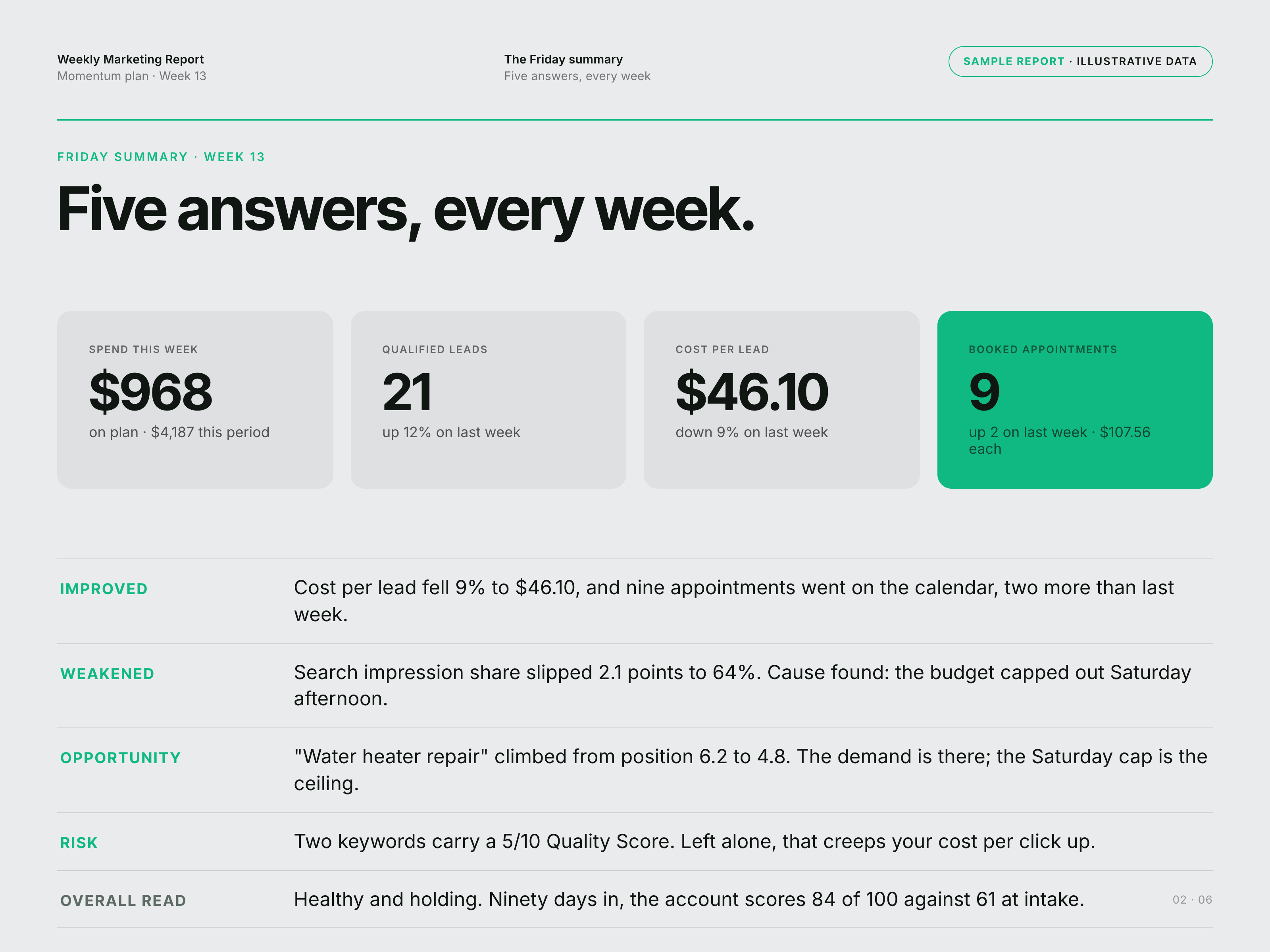
Friday summary · five answers, every week
Improved: leads +12%, cost per lead −9%
Weakened: impression share -2.1 pts
Opportunity: “water heater repair” rising on page 1
Risk: budget-capped Saturday afternoon
Spend
$968
on plan
Qualified leads
21
+12% vs last wk
Cost / lead
$46.10
-9% vs last wk
Impr. share
64%
-2.1 pts · budget-capped Sat
1
Spend & Delivery
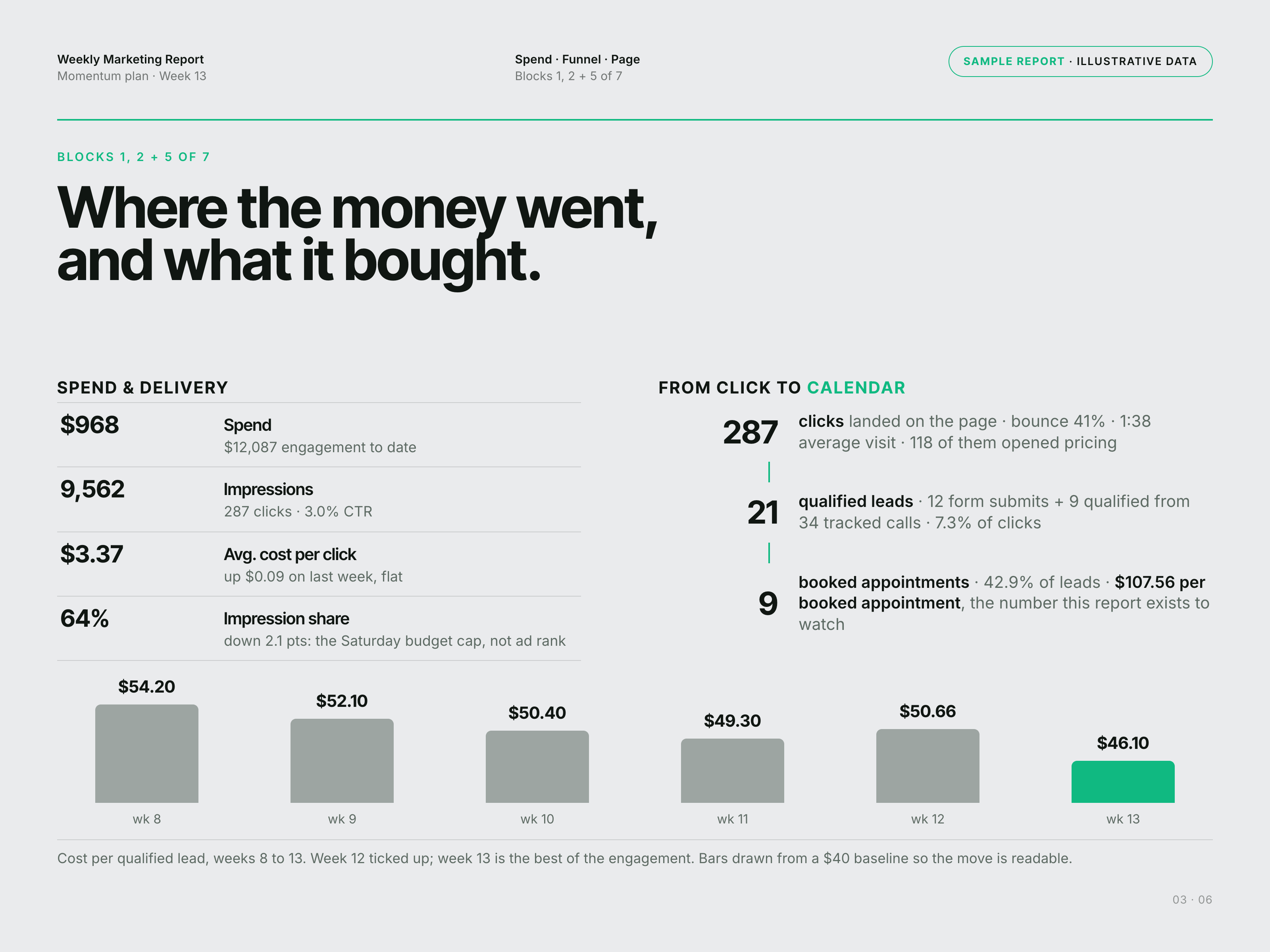
Spend, impressions, clicks, CTR, average CPC, and impression share, with the reason you missed share (rank vs budget).
2
Conversions & Funnel
Lead count and rate, cost per qualified lead, form submissions, and where the funnel narrows.
3
Search Intelligence
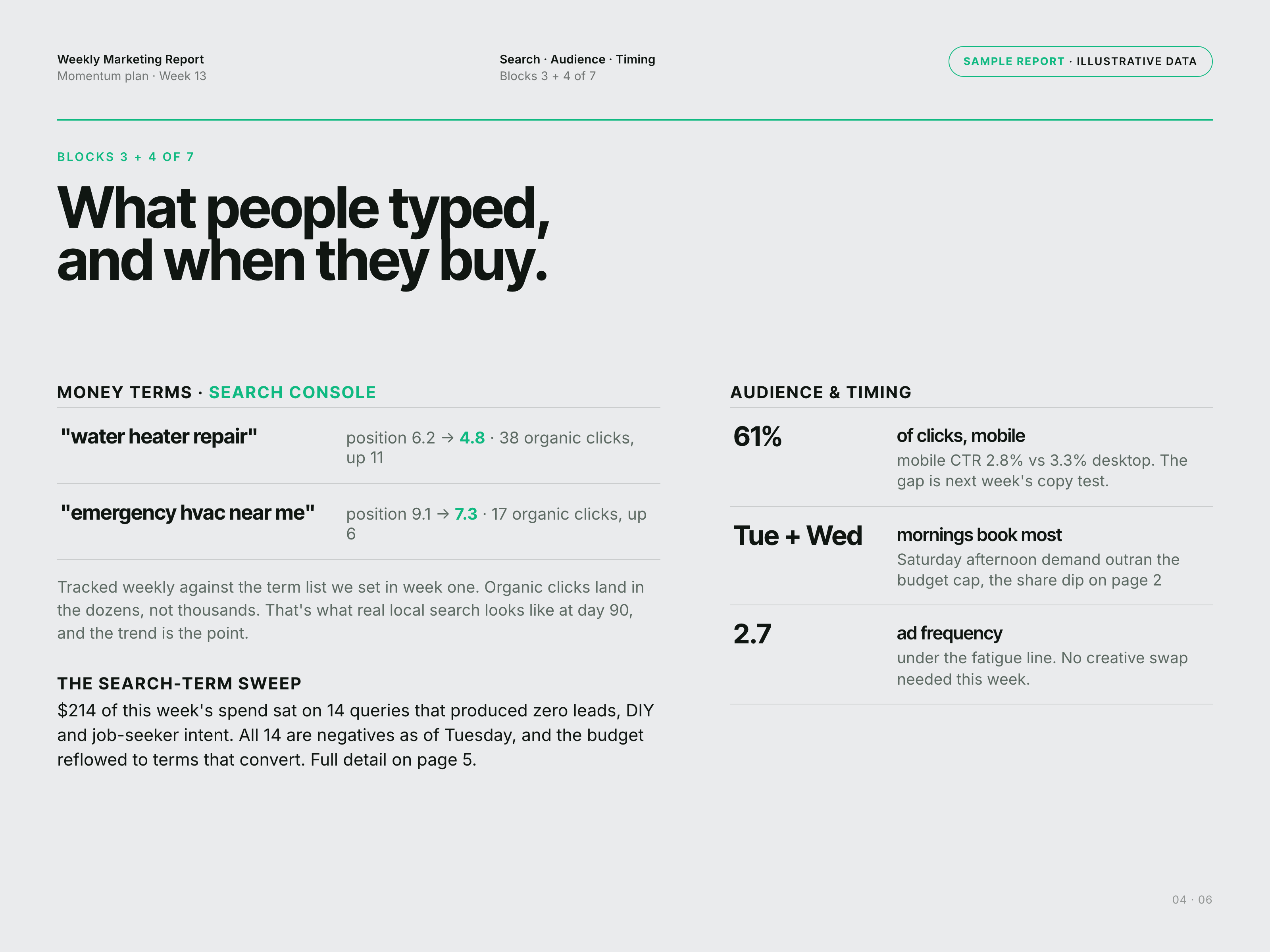
Top and worst keywords, the real search terms people typed, and the negatives we added this week.
4
Audience & Timing
Geography, device split, the days and hours that convert, and ad frequency before fatigue sets in.
5
Landing Page Engagement
Bounce, session length, pages per session, scroll depth, and which page the ad traffic dropped on.
6
Health & Recommendations
Rejected ads, Quality-Score flags, budget moves, and the exact keyword and copy changes we're making next.
7
Tracking Long-Term
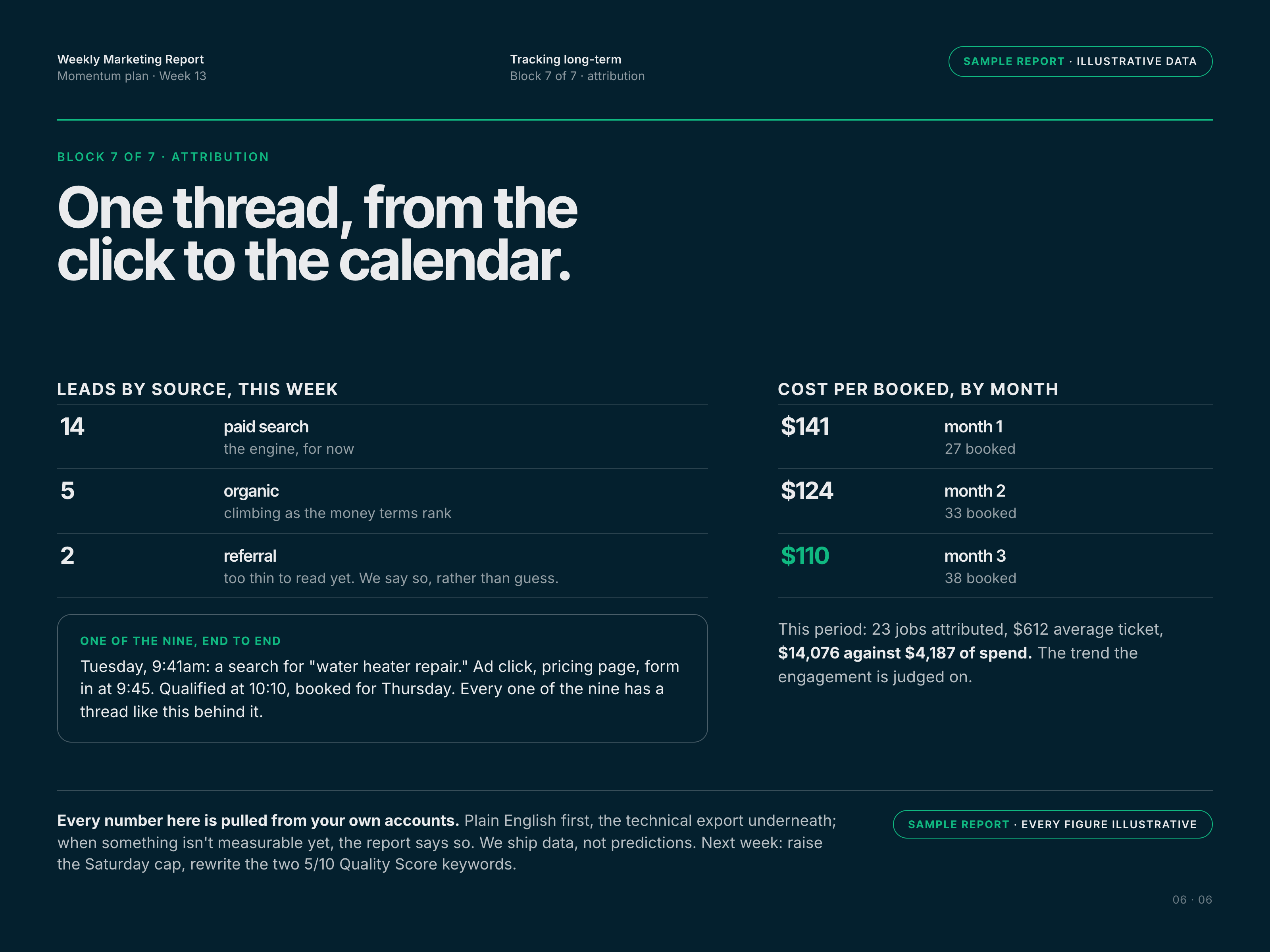
Estimated cost-to-acquire trend, then paid vs organic vs referral as attribution matures.
Sample data · illustrative. A realistic example month, not a client's numbers.
What we measure, and what it changes
Every number in your report has a lever attached.
Most agency reports are built to look busy. Ours runs the other way: every number below answers a question you'd actually ask, names the change it forces when it moves, and tells you how that change gets verified. Pick a service.
We score your account against 250+ checks every month, then tell you what one qualified lead actually cost, not what a click cost.
0–100 Ads Health Score
Is my ad spend healthy, or quietly leaking?
Monthly
→What it changes: Sets the month's fix list: the weakest dimensions get fixed first.
Verified by: Re-scored on next month's audit
Cost per qualified lead
What does one real lead actually cost me?
Monthly
→What it changes: Moves budget toward the terms and ads that produce leads.
Verified by: Next report's CPL line
Wasted-spend recovered
How much of my budget did we stop burning?
Monthly
→What it changes: Becomes that week's negatives batch.
Verified by: Change audit + the wasted-spend line
Landing-page relevance score
Does the page my ad points at match the ad?
Per campaign + on change
→What it changes: The winning ad's hook rewrites the page hero, word for word.
Verified by: Before/after change audit
Competitor benchmarkCOMMAND tier
Am I winning the auction against the shop down the street?
Monthly
→What it changes: Re-aims bids and copy where you're losing.
Verified by: Share trend next month
This is why we can stand behind cost per lead. The data is not the deliverable. The change it forces is, and the next report shows what it did.
The operating loop
The report doesn't just tell you what happened. It decides what we change.
A traditional agency hands you a dashboard and a monthly call. This system routes every signal to a named lever, ships the change through a before/after audit, and shows you the result in the next report.
1Instrument
One attribution thread, from the ad click to the captured lead. Every dollar traceable.
→
2Diagnose
Weekly: the 0–100 Health Score, the search-term sweep, funnel stages, money-term movement.
→
3Act
Each signal has a named lever. Copy, page, budget, negatives, SEO brief.
→
4Verify
Every change ships through a before/after audit, and next week's report shows the delta.
What a signal changes
The routing table we actually run. Left: what the data says. Right: what we do about it, and how you'll know it worked.
The signalThe lever it pullsVerified by
Search terms spending with zero leads
The lever it pulls
Negatives batch added; budget reflows to converting terms
Verified by
Next week's cost per lead + the wasted-spend line
A search term that converts profitably on paid
The lever it pulls
Promoted to exact match AND opened as an SEO content brief. Paid validates organic before a word is written
Verified by
GSC position tracking on that exact term
One ad hook outperforming on CTR and lead rate
The lever it pulls
Landing page hero re-message-matched to the winning hook, word for word
Verified by
Change audit before/after + the LP conversion stage
Funnel drop-off between pricing views and form submits
The lever it pulls
Proof reordering, CTA resistance kill-list, form friction pass
Verified by
Stage-conversion delta in the weekly report
A money term rising on page 2 of Google
The lever it pulls
Content brief targeting that exact query; paid budget eases off as organic takes it
Verified by
Position + click trend, blended cost per lead
An Ads Health Score dimension failing
The lever it pulls
That dimension's named fix lane in the audit framework
Verified by
Re-scored next audit
Impression share capped by budget at peak hours
The lever it pulls
Budget reallocation proposed with the data attached. You decide; spend never moves silently
Verified by
Impression-share trend after the change
Any site change, ours or anyone's
The lever it pulls
Before/after regression audit: what changed, what's at risk, which ads point at affected pages
Verified by
The change log line in the weekly report
One week inside the loop
Signal on Monday. Shipped by Wednesday. Verified by Friday.
A sample week from a representative account, the same one every mock on this site draws from. This is the cadence the report drives.
1Monday
The report flags three signals
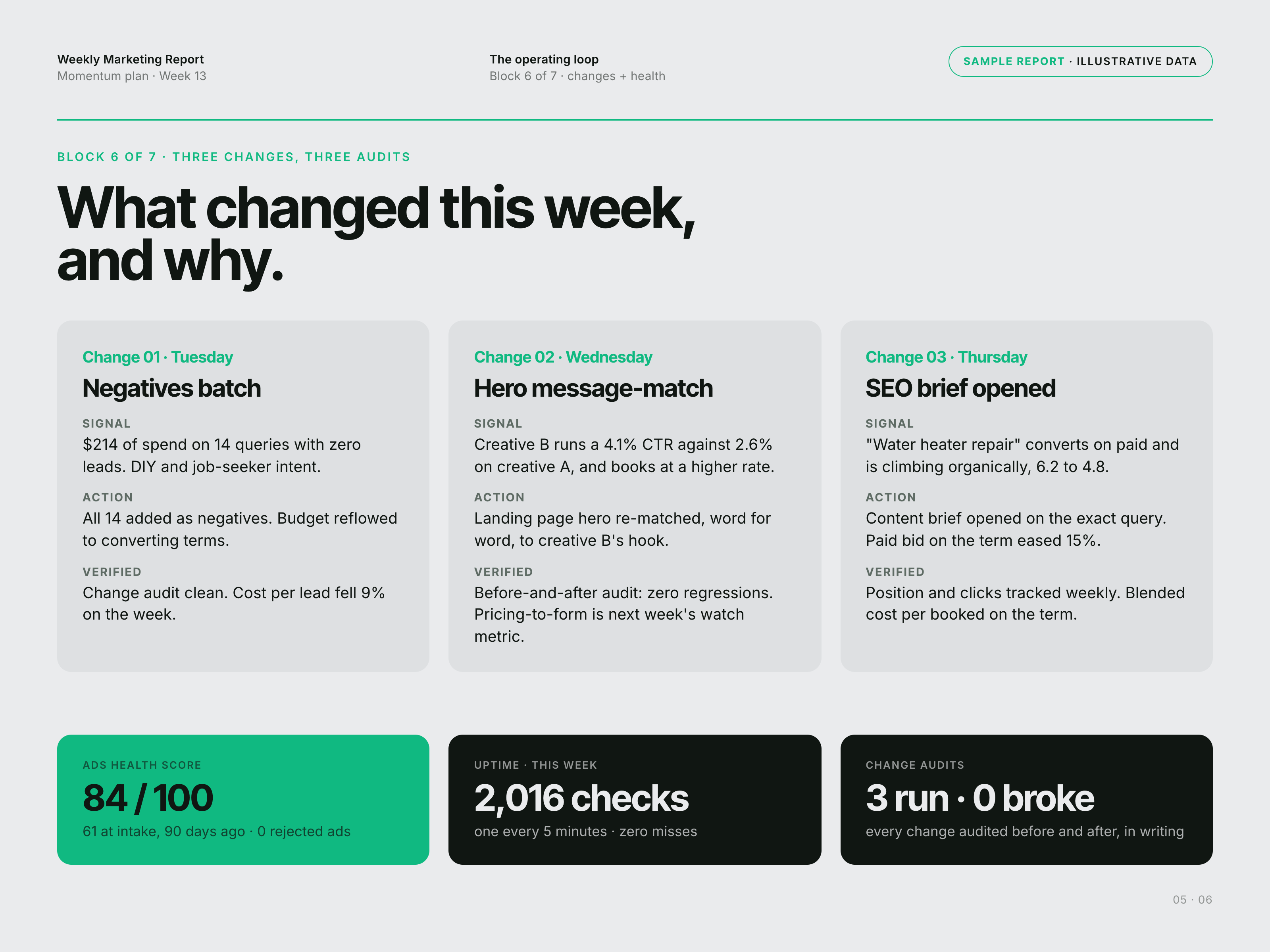
Search-term sweep: $214 of the week's spend sat on 14 queries that never produced a lead.
Creative B held 4.1% CTR against 2.6% on creative A, and turned more of its clicks into leads.
“water heater repair” converts on paid and is climbing organically (position 6.2 → 4.8).
2Tuesday
Each signal gets a named lever, not a meeting
Negatives added Tuesday; budget reflowed to the terms that convert.
Landing-page hero re-matched, word for word, to creative B's hook on Wednesday.
Content brief opened on the exact query; the paid bid eased off 15%.
3Wednesday
Every change ships through the before/after audit
What changed, what's at risk, and which live ads point at affected pages, checked before and after.
All three audits came back clean: 0 regressions.
4Friday
The next report shows what the changes did
Qualified leads +12% on the week; cost per lead down 9%.
Impression share -2.1 pts (budget-capped Saturday afternoon), flagged with the data attached. Budget moves are proposed, never silent.
Pricing-to-lead conversion is next week's watch-metric for the new hero.
Sample data · illustrative. A realistic example week, not a client's numbers.
The reliability layer · how Verify works
Every change audited. Your site checked every 5 minutes.
Before and after every change, we audit what changed, what's at risk, and which live ads point at affected pages. And your site is pinged every 5 minutes, content-verified, so a break is something we catch, not something you discover.
Change Impact · before / after auditSample
Hero re-matched to the winning ad hook
Snapshot taken before, re-checked after
Clean
3 internal links updated, all still resolve
1 CTA moved from header to hero, still works on mobile
1 image lost its alt text, flagged to restore
2 active ads point at this page, both checked, both fine
3
audits this wk
0
regressions
100%
uptime · 5-min checks
We run this on every change, and check your site every 5 minutes. You hear about a problem from us, not from a customer.
Sample data · illustrative. A realistic example month, not a client's numbers.
Uptime, checked every 5 minutes
Healthy means it returns a real, rendered page, not a blank 200. You get a plain-English alert only on a real up or down change, so you're never the last to know your own site went dark.
Content-verified, not just a status code.
Alerts only on real transitions, no noise.
You hear it from us first.
The questions owners actually ask
You'll wonder these. Here's the wiring that answers them.
These are the real questions a service-business owner asks, and the exact mechanism behind each answer. Not a promise, a method.
01
“Which ads are actually driving leads?”
We wire lead-intent clicks and phone-call clicks as primary conversions, then report cost per lead per keyword and per ad. You see which search term, which ad, drove the action.
02
“Is my tracking even working?”
We don't assert it, we prove it. We drive a real browser, click your live button, watch the event fire and the count move in realtime, and re-check it whenever a platform shows a misleading nudge.
03
“Am I wasting budget?”
Impression-share analysis tells you why you're not showing more, rank versus budget. We name the lever, so the fix is keywords and relevance when that's the problem, not just more spend.
04
“What do people actually search to find me?”
The search-terms report shows the real phrases people typed. We turn the winners into keywords and the wasted ones into negatives, every week.
05
“Will I know if my website breaks?”
Your site is checked every 5 minutes, content-verified, not just a blank 200. You get a plain-English alert only on a real change, and you hear it from us first.
06
“If you change my site, what could break?”
Before and after every change we audit what changed, what's at risk, which buttons and links are affected, and which live ads point at the page. A plain green, yellow, or red verdict.
07
“Am I losing leads when a form glitches?”
Every lead is captured to an independent system before the notification even sends, with a fallback if the email fails. We've found and replaced placeholder buttons that were silently dropping inquiries.
08
“Just tell me what's going on, in plain English.”
Every build, change, and finding gets a plain-English version first, the technical version underneath. The report is written to be read by you, not by another agency.
A report written to be read by you.
Plain English first, the technical version underneath. The loop produces this document every Friday, and you can read a full sample issue in the portfolio. Want your account seen through this lens? Start with the rescue.